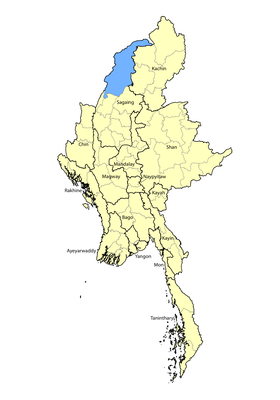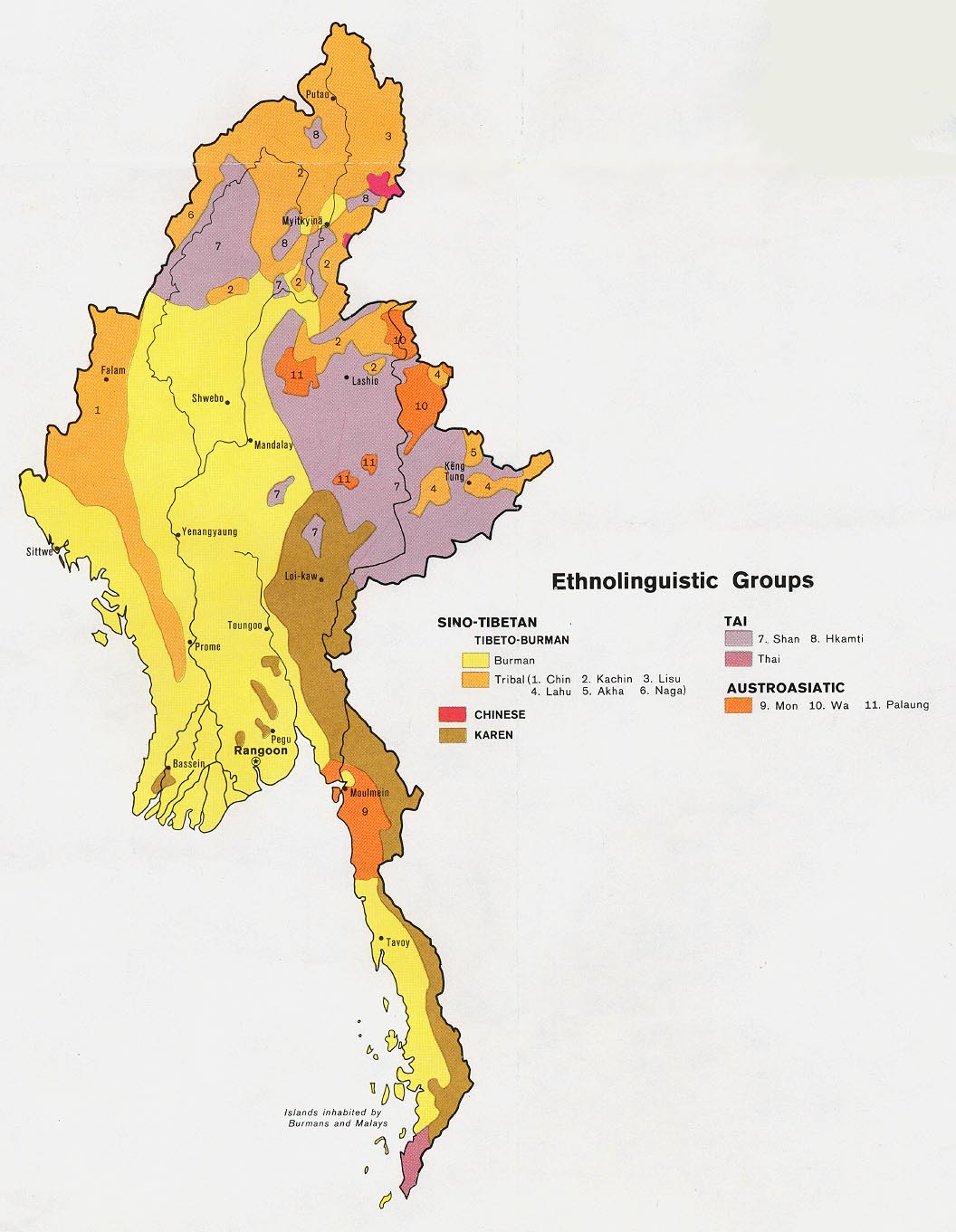

Distributed over 30 villages on the Myanmar side of the border with India, Ponyo Naga people live in Lahe Township within the large Sagaing Region, which is home to dozens of distinct tribes and people groups. Ponyo Naga territory "is a broad belt stretching from the headwaters of the Namtaik River near the Indian border down to the Chindwin River." Several hundred Ponyo people also live across the border in northeast India. Some fled there recently to escape the chaos of the Myanmar civil war, while others moved for their children's education or for business opportunities.
The Ponyo are so closely related to the smaller Gongwang tribe that scholars have combined their dialects to form a new language called Ponyo-Gongwang Naga. The two tribes maintain a distinct identity, however, and although outsiders have no hesitation in labelling them as one, "both groups deny a connection." The Ponyo do acknowledge historical links with the Lainong and Khiamniungan Naga tribes. Ponyo men have been described as "tall and of muscular physique. Their discipline, pride, and communal spirit gave them the reputation as the most impressive of Naga warriors."
Ponyo is one of several Naga languages in western Myanmar related to Northern Chin varieties, suggesting a historical link between the two. Scholars have found that Ponyo shares an 89% lexical similarity with Gongwang, 69% with Lainong, and 67% with Khiamniungan Naga. Despite vocabulary differences, most Ponyo people can communicate in all three of these neighboring vernaculars. Ponyo is spoken by all tribe members, and a Roman-based script has been used by them since 2014.
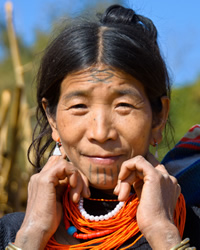
The Ponyo appear to come from the same root as today's Gongwang and Lainong Naga tribes, as all three groups acknowledge Noklak in India as their place of origin. Their ancestors "reputedly emerged from a hole in the ground and then moved eastwards, crossing the mountains near Ponyo Noakang to a flattened area where the people gathered after crossing." The Ponyo decided to remain there, but the other two tribes continued and settled in other areas. For centuries, special tattoos were given to warriors who took human heads. In 1927, a British army captain met one Ponyo man "who had taken so many heads that he had almost run out of space, and having filled his chest, back, arms, and legs, resorted to tattooing figures on his cheeks."
Headhunting raids were often launched in retaliation for an attack or insult, while a strong desire to appease the spirits undergirded the dark practice. In 1936, the Ponyo joined forces with their Gongwang counterparts and raided the Khiamniungan village of Pangsa, returning with 188 human heads and many prisoners of war. The village of Ponyo Noakang, which sits on the international border, "enjoyed a dubious reputation as the prime route for captives destined for human sacrifice in Myanmar."
Village life is central to their way of living. The Ponyo-Gongwang typically reside in small, close-knit communities where cooperation and mutual support are essential. Families often work together in the fields, build homes collectively, and share responsibilities during planting and harvest seasons. Leadership within the village is usually vested in respected elders or chiefs who guide decision-making and help maintain social harmony.
Their homes are generally simple structures made from locally available materials such as bamboo, wood, and thatch. These houses are adapted to the hilly terrain and climate, reflecting both practicality and tradition. Daily life is physically demanding, with much time devoted to farming, gathering forest resources, and maintaining the household.
After centuries of devotion to demons that caused the Ponyo Nagas to live in bondage and violence, they began converting to Christianity in the 1970s, and today an estimated 60% of the tribe are followers of Jesus. There are also significant numbers of Buddhists among them, while many families continue to observe the animistic rituals of their forefathers.
The spiritual growth of Ponyo Naga Christians in Myanmar has been hampered by a complete lack of Scripture or any other Christian resources in their heart language. Burmese Bibles are used, but many Ponyo people, especially the elderly, have limited understanding of the Burmese language.
Due to their remote location, the Ponyo-Gongwang have had limited access to modern infrastructure such as education, healthcare, and transportation. As a result, many aspects of their traditional lifestyle remain intact, though gradual changes are occurring as outside contact increases.
Pray for revival fire to bless Ponyo-Gongwang families and churches.
Pray that soon they will be discipling one another and members of Buddhist communities.
Pray for the Lord to use them powerfully for his kingdom.
Pray their physical needs will be met in such a way everyone will know they are blessed by the living God.
Scripture Prayers for the Naga, Ponyo-Gongwang in Myanmar (Burma).
Asia Harvest
1 Aglaja Stirn & Peter Van Ham, The Hidden World of the Naga: Living Traditions in Northeast India and Burma (London: Prestel Publishing, 2003), p. 38.
2 Stirn & Van Ham, The Hidden World of the Naga, p. 38.
3 Stirn & Van Ham, The Hidden World of the Naga, p. 38.
4 Summer Institute of Linguistics, Ethnologue: Languages of the World (27th edition, 2024), online version.
5 J. D. Saul, The Naga of Burma: Their Festivals, Customs, and Way of Life (Bangkok: Orchid Press, 2005), p. 29.
6 See H. J. Mitchell, Report on a Two Months' Tour in the Unadministered Area West of the Chindwin, Opposite Singkaling Hkamti (Rangoon, 1927), p. 11.
7 Saul, The Naga of Burma, p. 187.
8 Saul, The Naga of Burma, p. 15.
| Profile Source: Joshua Project |
| Other PDF Profile |